
The Legend of Ame-onna: Exploring Japan’s Rain Spirit
When travelers imagine Japan, they often picture cherry blossoms under a bright blue sky or the sun rising over Mount Fuji. However, anyone who has spent time in the archipelago during June or September knows that rain is an equally integral part of the Japanese experience. In the rich tapestry of Japanese folklore, this weather is personified by the Ame-onna (雨女), or “Rain Woman.”
Far from a simple weather forecast, the Ame-onna is a complex figure in Japanese mythology—a Yokai (spirit) that bridges the gap between ancient agricultural worship and modern superstitions.
Origins of the Spirit
The origins of the Ame-onna are as murky as the skies she summons. Unlike many Yokai that are born from specific violent deaths or objects attaining a soul, the Ame-onna appears to be a fallen deity. Folklore scholars believe she may be a degraded form of ancient Chinese rain goddesses who resided on Mount Wushan. In early agrarian Japan, rain was a blessing, vital for rice cultivation, and these deities were worshipped benevolently.
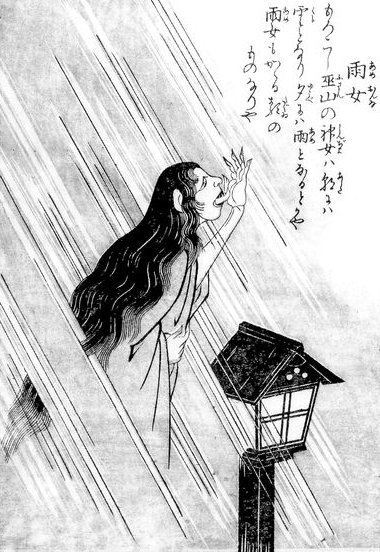
However, as legends evolved and oral traditions shifted, the benevolent rain bringer transformed. By the Edo period, specifically depicted in Toriyama Sekien’s famous bestiary Konjaku Gazu Zoku Hyakki (1779), the Ame-onna had become a Yokai. She was no longer a goddess to be prayed to, but a spirit to be wary of—a symbol of gloom, persistent dampness, and occasionally, sorrow.
The Legend of the Rain Woman
In classic folklore, the Ame-onna is depicted as a woman standing in the pouring rain, often licking the rain off her hands or arms like a wild animal. She is usually described as looking somewhat disheveled, wearing a wet kimono, and possessing an aura of deep melancholy.
One of the more sinister variations of the legend connects the Ame-onna to the Ubume (the ghost of a woman who died in childbirth). In these stories, the Ame-onna roams villages on rainy nights carrying a large sack. It is said she searches for newborn babies to kidnap, spiriting them away into the darkness. This darker aspect reflects the double-edged sword of rain in Japan: it gives life to crops but can bring floods, landslides, and disaster.
Despite these spooky tales, the prevailing image of the Ame-onna in later years became less malevolent and more pathetic—a lonely spirit who brings rain wherever she goes, unable to ever see the sun, perpetually soaked and sorrowful.
Ame-onna in Modern Culture
Today, the term “Ame-onna” has largely shed its terrifying supernatural connotations and has entered the Japanese vernacular as a lighthearted social label. If a woman attempts to plan a picnic, a wedding, or a vacation, and it rains on that specific day, she is jokingly labeled an Ame-onna. Her male counterpart is the Ame-otoko (Rain Man).
Conversely, a woman who seemingly brings sunshine wherever she goes is called a Hare-onna (Sun Woman). This superstition is surprisingly prevalent in modern Japan. You will often hear friends apologizing for “being an Ame-onna” if a group trip gets rained out.
Pop culture has also embraced this figure. From the weather-manipulating themes in Makoto Shinkai’s anime film Weathering with You (Tenki no Ko) to various characters in the Pokémon and Yo-Kai Watch franchises, the concept of a female spirit tied to the rain remains a staple of Japanese storytelling. She represents the necessity of balance—without the rain, there is no life, even if the rain brings sadness.
Traveler’s Tips: Embracing the Rain
If you find yourself traveling in Japan during Tsuyu (the rainy season in June and July) or the typhoon season in September, you might feel like you are being followed by an Ame-onna. Instead of hiding indoors, embrace the atmosphere.
1. Visit “Hydrangea Temples”
The rainy season is synonymous with Ajisai (hydrangeas). Temples like Meigetsu-in in Kamakura or Mimuroto-ji in Kyoto are stunning in the rain, where the water intensifies the blue and purple hues of the flowers.
2. Seek out Moss Gardens
Japanese gardens, particularly the moss gardens of Saiho-ji (Kokedera) in Kyoto, look their absolute best during a drizzle. The moss glows with a vibrant, velvety green that dry, sunny days simply cannot replicate.
3. Onsen Retreats
There are few experiences more magical than sitting in an outdoor rotenburo (hot spring bath) with the cool rain falling on your face while your body remains hot. It is the perfect way to make peace with the weather.
Sources & Further Reading
For those interested in diving deeper into the world of Japanese spirits and the origins of the Ame-onna, the following texts and collections are essential:
- Konjaku Gazu Zoku Hyakki by Toriyama Sekien (1779) – The visual foundation for many modern Yokai, including the Ame-onna.
- The Kojiki and The Nihon Shoki – While they do not explicitly name the “Ame-onna” as a Yokai, these ancient chronicles detail the Shinto deities of rain and storms (such as Susanoo) that form the basis of elemental worship in Japan.
- Yokai Attack! The Japanese Monster Survival Guide by Hiroko Yoda and Matt Alt – A modern, accessible look at various creatures of folklore.