
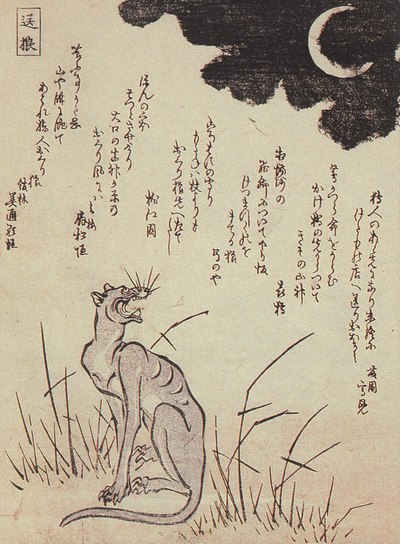
Meeting the Okuri-inu: Japan’s Demon Dog of the Mountains
Imagine walking alone on a narrow mountain pass in Japan at twilight. The cedar trees tower above, blocking out the fading light, and the silence is deafening. Suddenly, you hear the crunch of dry leaves behind you. You stop; the sound stops. You walk; the sound resumes. You are not alone. According to Japanese folklore, you have just attracted the attention of the Okuri-inu (送り犬), or the “Sending Dog.”
For cultural travelers and folklore enthusiasts, the Okuri-inu is one of the most fascinating creatures in the Japanese pantheon of yokai (spirits/monsters). It represents the dual nature of the wild: a force that can protect you or destroy you, depending entirely on your behavior.
Origins and Etymology
The name Okuri-inu literally translates to “Sending Dog” or “Escorting Dog.” While the term “demon” is often used in translation, the creature is closely tied to the real, now-extinct Japanese wolf (Canis lupus hodophilax). In ancient Japan, wolves were not seen purely as pests but as mountain guardians. Farmers worshipped them for protecting crops from deer and wild boars.
This reverence birthed the legend of the Okuri-inu. Originating primarily in the Izu Peninsula and the mountainous regions of central Japan, stories describe a dog-like spirit that trails travelers at night. Unlike the Okuri-okami (Sending Wolf), which is largely considered a benevolent protector, the Okuri-inu straddles the line between a guardian and a predator. It is a manifestation of the dangers inherent in mountain travel during the Edo period.
The Legend: Rules of the Trail
The behavior of the Okuri-inu is governed by a strict set of supernatural rules. If you find yourself followed by this spectral hound, your survival depends on your composure.
The Stumbling Block
The most famous aspect of the legend concerns stumbling. It is said that the Okuri-inu follows travelers closely—so closely that its nose might brush against their heels. As long as you keep walking, it will protect you from other, more malicious yokai. However, if you trip and fall, the Okuri-inu will pounce and devour you instantly.
The Life-Saving Bluff
Folklore provides a loophole for the clumsy traveler. If you do fall, you must immediately pretend that you did so on purpose to take a rest. You should sit up, sigh, and say something like, “Dokkoisho” (a sound made when heaving a heavy load or sitting down) or, “I think I’ll rest for a while.”
By framing the fall as a deliberate pause, you trick the Okuri-inu into waiting for you. Once you stand up and resume walking, the dog will continue its escort duties rather than attacking.
The Proper Send-Off
If you manage to reach the edge of the village or your home safely, the engagement isn’t quite over. You must turn around and thank the spirit. The phrase usually cited is, “Thank you for seeing me off.” Some legends suggest leaving a handful of rice or salt as a payment for its protection. Failure to show gratitude might result in the dog returning to claim you later.
Modern Culture and Media
While the Japanese wolf went extinct in the early 20th century, the Okuri-inu lives on in pop culture. In the modern era, the creature has shifted from a cautionary superstition to a character archetype.
- Anime and Manga: The Okuri-inu appears in famous series like GeGeGe no Kitaro, where it is often depicted more as a monster than a guardian. In the Yokai Watch franchise, it is reimagined for a younger audience.
- Literature: Modern horror authors in Japan frequently use the trope of the “follower in the dark,” a direct descendant of this legend.
The persistence of the Okuri-inu in media highlights Japan’s deep nostalgia for its lost wilderness and the mysteries that used to hide in the dark corners of the country.
Traveler’s Tips: Experiencing the Myth
For travelers visiting Japan, you can still experience the atmosphere that gave rise to these legends. Here is how to incorporate the Okuri-inu into your itinerary:
- Visit Mitsumine Shrine (Chichibu, Saitama): This is the heart of wolf worship in Japan. Instead of the standard Komainu (lion-dogs) guarding the entrance, this shrine features statues of wolves. It is a spiritual place where the connection between the Okuri-inu legend and the worship of mountain gods is palpable.
- Night Hikes: If you are an experienced hiker, guided night treks in regions like Nagano or Yamanashi can simulate the eerie atmosphere of the legend. (Just watch your footing!)
- Local Souvenirs: In areas known for wolf legends, look for Omamori (amulets) that feature wolf iconography, believed to protect against fire and theft.
Sources & Further Reading
To deepen your understanding of Japanese folklore and the Okuri-inu, consider exploring the following texts:
- “The Legends of Tono” (Tono Monogatari) by Yanagita Kunio: A pivotal collection of Japanese folk tales that captures the essence of rural superstitions.
- “Nihon Shoki” (The Chronicles of Japan): While focused on imperial history and Shinto gods, this ancient text establishes the early spiritual geography of Japan that allowed yokai folklore to flourish.
- “Yokai Attack! The Japanese Monster Survival Guide” by Hiroko Yoda: A modern, accessible guide to understanding the rules of engagement with creatures like the Okuri-inu.
The Okuri-inu serves as a reminder that in Japan, nature is never truly empty. It is watching, waiting, and—if you are polite—protecting.