
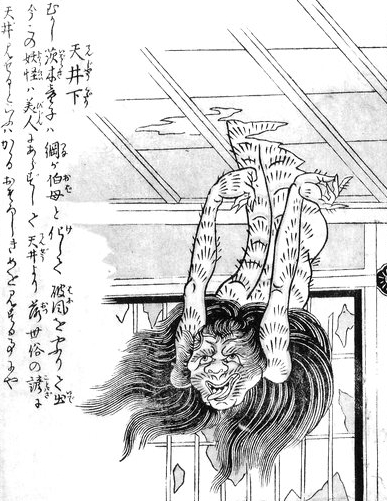
Tenjo-kudari: The Eerie Dweller of the Ceiling
Imagine staying in a centuries-old Japanese inn (ryokan). The tatami mats smell of fresh straw, and the sliding paper doors rattle slightly in the wind. You lie down on your futon, staring up at the dark, wooden grain of the ceiling, trying to fall asleep. Suddenly, the wood grain shifts. A disheveled head emerges, followed by a body hanging upside down, staring directly at you. You have just met the Tenjo-kudari.
While Japanese folklore is filled with terrifying demons and mischievous spirits, the Tenjo-kudari (天井下り) occupies a specific niche of domestic horror. Literally translating to “Ceiling Descender,” this yōkai turns the safety of one’s home into a source of dread. In this guide, we will explore the origins of this inverted spirit, the legends surrounding her, and where travelers can experience yōkai culture in Japan today.
Origins of the Ceiling Descender
Unlike the ancient gods found in Japan’s creation myths, the Tenjo-kudari is a relatively “modern” invention in the timeline of Japanese folklore, dating back to the Edo period (1603–1867).
The spirit was popularized—and likely invented—by the famous ukiyo-e artist and folklorist Toriyama Sekien. It first appeared in his 1784 collection, Gazu Hyakki Tsurezure Bukuro (The Illustrated Bag of One Hundred Random Demons). Sekien was known for cataloging existing oral legends but also for creating new yōkai based on puns or satirizing human behavior.
Folklore scholars believe the Tenjo-kudari may be a counterpart or a parody of another ceiling-dwelling spirit called the Tenjo-name (Ceiling Licker). While the Ceiling Licker is a grotesque creature that cleans the ceiling with a long tongue, the Tenjo-kudari is almost always depicted as a human woman, adding a layer of psychological horror to the mix. The image of a woman hanging upside down may have been inspired by the layout of traditional Japanese architecture, where the space between the ceiling and the roof was dark, dusty, and prone to making strange noises.
The Legend: A Silent Watcher
The Tenjo-kudari is typically depicted as an ugly, disheveled old woman or sometimes a pale, younger woman with long, unkempt hair. According to the lore, she does not physically attack humans. She has no claws to rend flesh, nor does she possess fire breath.
Instead, her terror is purely psychological. She lives in the attic spaces of old houses. In the dead of night, she emerges through the ceiling boards, hanging upside down to stare at the sleeping inhabitants below.
The Connection to Osakabe-hime
Some legends loosely associate the Tenjo-kudari with the story of Osakabe-hime, a powerful spirit said to inhabit the keep of Himeji Castle. Osakabe-hime was a recluse who lived in the upper floors of the castle and knew the hearts of humans. While Osakabe-hime is a named deity-like figure and Tenjo-kudari is a generic species of monster, the imagery of a woman hiding in the upper rafters connects them in the cultural consciousness.
There is also a cautionary aspect to the legend. It is said that if you keep your house messy or untidy, you are more likely to attract a Tenjo-kudari. In this sense, she serves as a supernatural housekeeper, scaring residents into maintaining cleanliness.
Modern Culture and Media
Despite being a creation of the Edo period, the Tenjo-kudari has found a permanent home in modern Japanese pop culture. The visual of a woman crawling on the ceiling is a staple of J-Horror, most notably seen in films like The Grudge (Ju-On), though that specific spirit is different.
Anime and Manga:
- GeGeGe no Kitaro: In Shigeru Mizuki’s definitive yōkai series, the Tenjo-kudari appears as an antagonist. Mizuki’s portrayal cemented the creature’s status in the modern pantheon of Japanese monsters.
- Yokai Watch: This popular video game and anime franchise features a cute, modernized version of the spirit, introducing the concept to a new generation of children.
Video Games: From Nioh to Shin Megami Tensei, the Tenjo-kudari often appears as a generic enemy type or a summonable demon, usually retaining her classic design of a woman suspended from the air.
Traveler’s Tips: Seeking the Spirit
If you are a folklore enthusiast visiting Japan, you won’t find a Tenjo-kudari in a modern hotel in Tokyo. However, you can immerse yourself in the atmosphere that created her.
1. Mizuki Shigeru Road (Sakaiminato, Tottori)
This is the ultimate pilgrimage for yōkai lovers. The hometown of manga artist Shigeru Mizuki features over 170 bronze statues of different spirits lining the streets. You can find statues and artwork of the Tenjo-kudari here. The Mizuki Shigeru Museum offers a deep dive into the history of these monsters.
2. Yōkai Street (Kyoto)
Located on Ichijo-dori in Kyoto, this shopping street is dedicated to the Tsukumogami (tools that gain a spirit). The shops decorate their storefronts with homemade monsters. It is a whimsical look at the supernatural side of the ancient capital.
3. Stay in a Kominka
To truly understand the fear of the Tenjo-kudari, book a stay in a Kominka (traditional folk house). Many rural areas like the Iya Valley or Shirakawa-go offer renovations of these old wooden homes. Lying on the floor looking up at the high, dark wooden beams, you might just understand why people in the Edo period believed something was watching them from above.
Sources & Further Reading
- Toriyama Sekien: Gazu Hyakki Tsurezure Bukuro (The Illustrated Bag of One Hundred Random Demons), 1784.
- Mizuki Shigeru: Mizuki Shigeru no Nihon Yōkai Meguri.
- Michael Dylan Foster: The Book of Yokai: Mysterious Creatures of Japanese Folklore (University of California Press).
- Relevant Classical Texts: While Tenjo-kudari is an Edo-creation, for context on early Japanese supernatural beliefs, refer to the Konjaku Monogatari Shu (Tales of Times Now Past).