
Ame-onna: Understanding the Japanese Rain Woman Spirit
Have you ever planned a perfect vacation, only for the skies to open up the moment you step out of the hotel? If this happens to you frequently, Japanese folklore might label you an Ame-onna (雨女), or “Rain Woman.” While today the term is used playfully to describe someone with bad weather luck, the origins of the Ame-onna are rooted in the deep, mysterious history of Japanese yokai (spirits/monsters) and ancient agricultural worship.
The Origins of the Rain Woman
The concept of the Ame-onna is a fascinating blend of divine reverence and eerie folklore. Unlike many yokai that are born from tragedy or malice, the Ame-onna likely traces her lineage back to ancient rain deities.
Scholars believe the figure was originally adapted from Chinese mythology, specifically the legend of the Goddess of Mount Wushan. In ancient texts, she appeared as a morning cloud and evening rain, a benevolent spirit ensuring the vitality of the land. When this concept migrated to Japan—a nation heavily reliant on wet-rice agriculture—the ability to call forth rain was seen as godlike.
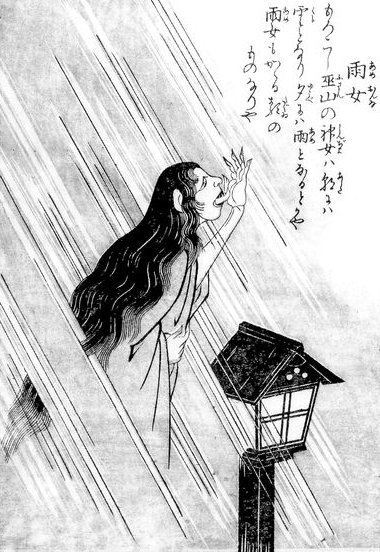
However, as with many Japanese legends, the Edo period (1603–1867) transformed her. The famous artist Toriyama Sekien, in his seminal work Konjaku Gazu Zoku Hyakki (The Illustrated Hundred Demons from the Present and the Past), depicted the Ame-onna not as a goddess, but as a yokai. In his illustration, she stands in the pouring rain, licking her hand, cementing her status in the popular imagination as a spirit of the damp and dark.
The Legend: Savior or Snatcher?
The folklore surrounding the Ame-onna is dual-natured, reflecting humanity’s complex relationship with nature.
In her benevolent form, she is a savior to farmers. During periods of devastating drought, villagers would pray for her arrival. It was believed that wherever she walked, clouds would gather, and rain would fall, saving the crops from withering. In this context, she is a holy figure, respected and welcomed.
However, the urban legends and ghost stories paint a more sinister picture. In these tales, the Ame-onna is a depraved spirit that roams the streets on rainy nights. She is often depicted as a haggard woman soaking wet, carrying a black umbrella or wearing a straw raincoat. Legend says she wanders looking for newborn babies. If she hears a child crying, she may spirit them away into the night, hiding them in the folds of her spiritual realm where it rains eternally. Some stories suggest she licks the dampness off unsuspecting travelers or the wet hands of children, a grotesque image that moves her firmly into the category of horror.
Modern Culture: The Social “Ame-onna”
In contemporary Japan, the scary connotations have largely evaporated, leaving behind a social label. Today, being called an Ame-onna (or her male counterpart, Ame-otoko) is a common, slightly self-deprecating joke.
If a woman goes on a picnic and it rains, or plans a wedding that gets stormed out, she is teased for being an Ame-onna. It implies that her spiritual energy naturally attracts precipitation. Conversely, someone who always enjoys clear skies is called a Hare-onna (Sunny Woman).
This trope is ubiquitous in Japanese pop culture, particularly in anime and manga. Characters associated with gloom or water magic are often referred to as Ame-onna. A prime example is Juvia Lockser from the series Fairy Tail, who is perpetually followed by rain until she resolves her emotional turmoil. Similarly, the hit film Weathering With You (Tenki no Ko) explores the deep cultural connection between shrine maidens and the control of weather, modernizing the ancient myth for a new generation.
Traveler’s Tips: Embracing the Rain
If you visit Japan and find yourself acting as an inadvertent Ame-onna, do not despair. Japan is arguably one of the most beautiful countries to explore in the rain. Here is how to handle the weather like a pro:
1. Visit During Tsuyu (Rainy Season)
While most avoid June and early July, the Tsuyu season offers a unique atmosphere. The hydrangeas (ajisai) bloom vividly in blue, purple, and pink, looking their best under grey skies. Temples in Kamakura, such as Meigetsu-in, are famous for these rainy views.
2. Seek Out Water Shrines
Embrace the folklore by visiting shrines dedicated to water deities. Kibune Shrine in Kyoto is legendary for its water fortune slips (mizu-ura mikuji), where the text only appears when the paper is dipped in water. It is a perfect spiritual stop for a Rain Woman.
3. Gear Up
Japanese umbrellas are iconic. Buy a high-quality clear plastic umbrella from a convenience store (surprisingly durable and stylish in Japan) or invest in a traditional wagasa (oil-paper umbrella) for photos. The rain makes the neon lights of Shinjuku or Dotonbori reflect beautifully on the pavement, offering incredible photography opportunities.
Sources & Further Reading
For those interested in diving deeper into the mythological roots of Japanese spirits, the following texts and locations are recommended:
- Konjaku Gazu Zoku Hyakki (1779) by Toriyama Sekien: The visual source for the modern depiction of the Ame-onna.
- The Kojiki and Nihon Shoki: While they do not mention the specific “Ame-onna” yokai, these ancient chronicles provide the essential context for Japanese nature worship and the pantheon of agricultural gods.
- Legends of Mount Wushan: To understand the Chinese origins of the rain goddess archetype that influenced the Japanese interpretation.