
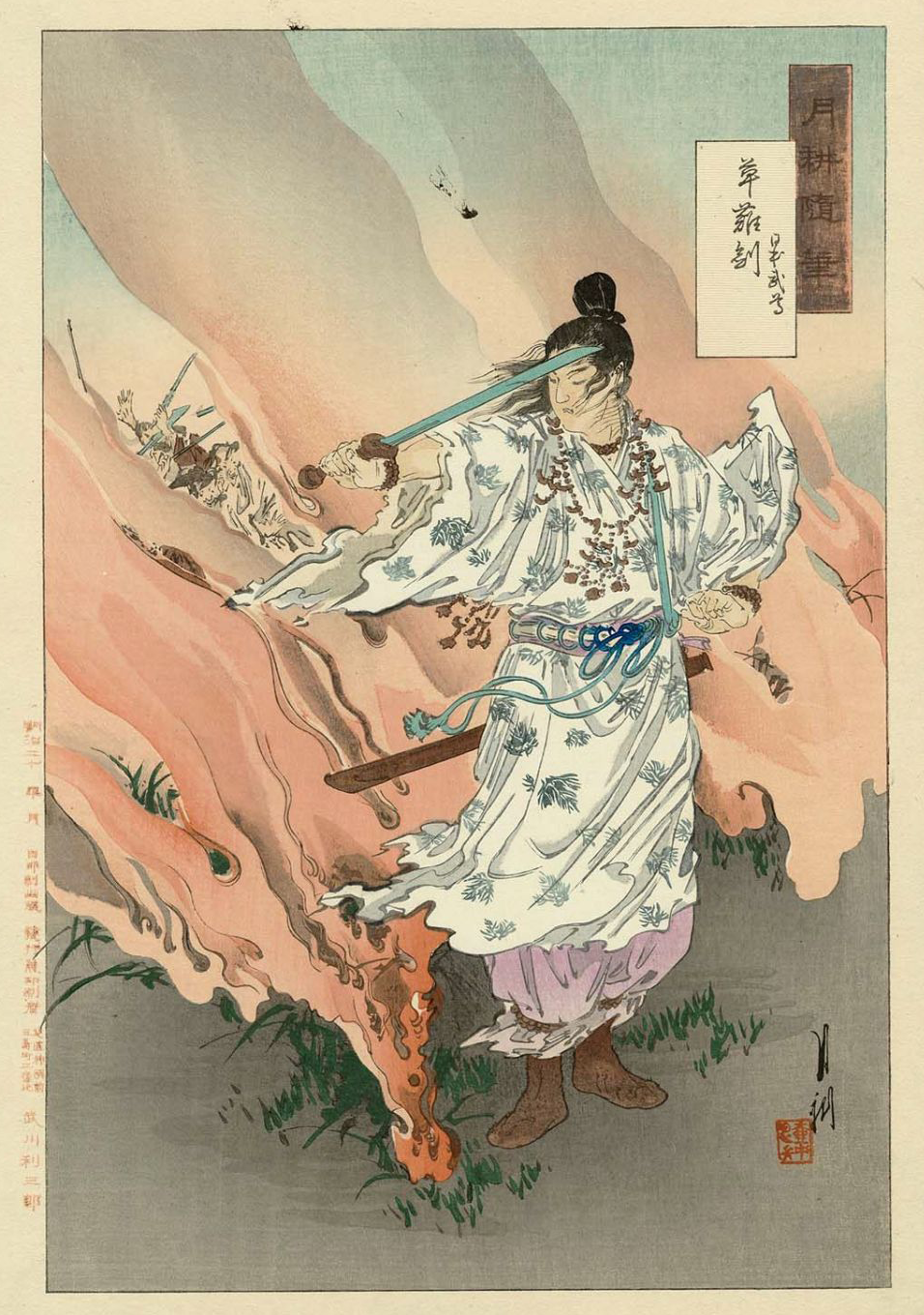
Unveiling the Mystery of Ame-no-Murakumo (Kusanagi)
Japan is a land deeply intertwined with mythology, where the lines between ancient history and spiritual folklore often blur. Among the most potent symbols of this intersection are the Imperial Regalia of Japan, known as the Sanshu no Jingi. While the mirror represents wisdom and the jewel represents benevolence, the sword—Ame-no-Murakumo-no-Tsurugi—represents valor.
Often compared to King Arthur’s Excalibur, this legendary blade holds a status of reverence that commands the respect of an entire nation. Yet, unlike Western artifacts found in museums, this sword remains shrouded in absolute secrecy, hidden away from the public eye. In this article, we journey through the mists of time to uncover the story of the “Heavenly Sword of Gathering Clouds.”
The Origins: A Blade Born of Storms
While commonly referred to today as Kusanagi-no-Tsurugi (The Grass-Cutting Sword), the weapon’s original name was Ame-no-Murakumo-no-Tsurugi. This poetic title translates roughly to “Sword of the Gathering Clouds of Heaven.”
According to ancient records, the sword is not merely a weapon of war but a divine artifact that legitimizes the rule of the Japanese Emperor. It is said that the sword possesses the spirit of the gods, acting as a bridge between the celestial plain and the earthly realm. Historically, its physical form is believed to represent the bronze swords of the Yayoi period, though no living person outside of a select few within the Imperial household and high priesthood has ever laid eyes on it.
The Legend: Susanoo and the Eight-Headed Serpent
The most famous tale regarding the sword comes from Japan’s age of the gods. The storm god Susanoo, having been banished from heaven, descended to the province of Izumo. There, he encountered an elderly couple weeping over their last surviving daughter, Kushinada-hime. They explained that a terrifying monster, Yamata-no-Orochi—an eight-headed, eight-tailed dragon—had devoured their other seven daughters and was coming for the last one.
Susanoo struck a deal: he would slay the beast in exchange for Kushinada-hime’s hand in marriage. To defeat the dragon, Susanoo didn’t rely solely on brute strength but on wit. He set out eight vats of strong sake. The gluttonous serpent drank deeply with each of its eight heads and fell into a drunken stupor.
Seizing the moment, Susanoo drew his own sword and began chopping the dragon into pieces. When he attempted to cut the dragon’s tail, his blade chipped. Curious, he sliced the tail open to reveal a magnificent sword hidden inside. This was the Ame-no-Murakumo-no-Tsurugi. To reconcile with his sister, the sun goddess Amaterasu, Susanoo gifted the divine blade to her.
From Clouds to Grass: The Renaming
Generations later, the sword was gifted to the great warrior Yamato Takeru. During a hunting expedition, a treacherous warlord lured Takeru into a trap, setting the surrounding grasslands on fire to burn him alive. Desperate, Takeru used the sword to cut away the burning grass. Legend states the sword controlled the wind, blowing the flames back toward his enemies. From that day forward, the blade was known as Kusanagi-no-Tsurugi—the Grass-Cutting Sword.
Modern Culture and Significance
Today, the sword remains a vital part of the Japanese Imperial enthronement ceremonies. During the transition of power from one Emperor to the next, the Kusanagi (or a replica used for the ceremony) is presented as proof of the emperor’s divine right to rule.
The legend of the sword has also permeated global pop culture. Fans of anime, manga, and video games will recognize the name Kusanagi or Ame-no-Murakumo in franchises like Naruto, One Piece, and the Final Fantasy series. It serves as a shorthand for ultimate power and divine provenance in Japanese storytelling.
Traveler’s Tips: Visiting the Sword’s Resting Place
For travelers and culture enthusiasts, the physical location of the sword is Atsuta Jingu (Atsuta Shrine) in Nagoya. While you cannot see the sword itself—it is kept deep within the inner sanctum, sealed away—the shrine is a must-visit destination.
- The Atmosphere: Atsuta Jingu is located in a vast, wooded park that offers a serene escape from the bustle of Nagoya city. Walking through the giant torii gates and ancient camphor trees, you can feel the spiritual weight of the history resting there.
- The Museum: Visit the Treasure Hall (Bunkaden) within the shrine complex. While Kusanagi is not there, the museum houses thousands of other historical swords, mirrors, and ancient documents that give context to the craftsmanship of the era.
- Local Delicacy: After soaking in the history, head to a restaurant near the shrine to try Hitsumabushi, a famous Nagoya eel dish. It is the perfect culinary end to a historical day trip.
- Etiquette: Remember to bow once at the torii gate before entering and leaving. At the main altar, the custom is to bow twice, clap twice, pray, and bow once more.
Sources & Further Reading
To dive deeper into the mythology of the Kusanagi and the Japanese gods, the following classical texts are essential reading:
- The Kojiki (Records of Ancient Matters): The oldest extant chronicle in Japan, dating from the early 8th century.
- The Nihon Shoki (The Chronicles of Japan): The second-oldest book of classical Japanese history, offering more detailed accounts of the Imperial lineage.
- The Tale of the Heike: For accounts of the sword’s alleged loss at the Battle of Dan-no-ura in 1185 (though priests claim the sword at Atsuta is the original).