
The Mystery of Azukiarai: Japan’s Bean-Washing Spirit
If you find yourself walking along a quiet mountain stream in Japan at twilight, listen closely. Amidst the rushing water, you might hear a peculiar, rhythmic scrubbing sound: shoki, shoki, shoki. This is not a washerwoman finishing her laundry, nor is it a trick of the wind. According to Japanese folklore, you have likely stumbled upon the territory of the Azukiarai (小豆洗い), the “Bean Washer.”
While Japan is home to countless yōkai (supernatural entities), few are as specifically eccentric or as widely recognized as this small, hunchbacked spirit obsessed with cleaning red beans. In this guide, we dive deep into the lore of the Azukiarai, separating the scary from the silly.
Origins and Etymology
The name Azukiarai translates literally to “Azuki Bean Washer.” The azuki bean is a staple in Japanese cuisine, traditionally used in sweets and celebratory rice dishes (sekihan). However, in the context of Edo-period folklore, the mundane act of washing these beans takes on a supernatural edge.
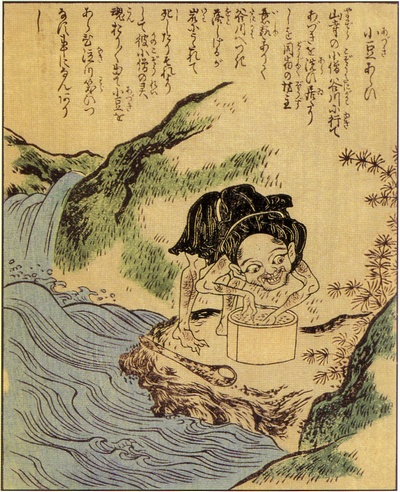
The visual depiction of the Azukiarai was solidified by Toriyama Sekien, the master scholar and artist of the 18th century. In his seminal work, Gazu Hyakki Yagyō (The Illustrated Night Parade of a Hundred Demons), Sekien depicted the spirit as a grotesque, balding figure with bulging eyes and a crooked grin, hunched over a wooden tub by a stream. While the origins of yōkai can often be traced back to fears of nature, the Azukiarai is widely believed to be a personification of the strange, unidentifiable sounds heard near rivers—perhaps created by rocks grinding together or small animals scurrying along the banks.
The Legend: “Shall I Grind Beans, or Eat a Human?”
The Azukiarai is primarily an auditory phenomenon. The legend varies slightly by region (from Niigata to Shikoku), but the core encounter remains consistent. A traveler walking near a riverbank hears the sound of beans being washed in a sieve (zaru).
Accompanying the sound of scrubbing (shoki, shoki), a raspy voice sings a chilling song:
“Azuki togō ka, hito totte kuō ka? shoki shoki…”
(Shall I grind my beans, or shall I catch a human and eat them? Scrub, scrub…)
Despite this terrifying threat, the Azukiarai is rarely dangerous. It is classified as a trickster spirit rather than a malevolent demon. If a curious human approaches the noise to investigate, the spirit usually vanishes, or the traveler slips and falls into the water—much to the invisible spirit’s amusement. In some regional variations, the Azukiarai is actually a transformed weasel or raccoon dog (tanuki), animals famous in Japanese folklore for their shapeshifting and prank-playing abilities.
Modern Culture: From Riverbanks to Anime
In contemporary Japan, the Azukiarai has shed much of its terrifying reputation and become a beloved character in pop culture.
Anime and Manga
The most famous depiction comes from Shigeru Mizuki’s iconic series, GeGeGe no Kitaro. Here, the Azukiarai is portrayed as a harmless, somewhat goofy old man who is friends with the protagonist. This portrayal single-handedly transformed the spirit’s image from a creepy river ghoul to a lovable mascot.
Video Games
Gamers might recognize the Azukiarai in titles like Nioh 2, where it appears as an NPC, or the Yo-kai Watch series, where it is depicted as a trio of bean-washing spirits. These adaptations highlight the enduring appeal of the character’s simple, distinct design.
Traveler’s Tips: Seeking the Bean Washer
For cultural travelers and folklore enthusiasts, “hunting” for the Azukiarai offers a unique way to explore rural Japan.
- Visit Sakaiminato (Tottori Prefecture): This is the hometown of Shigeru Mizuki. The famous Mizuki Shigeru Road features over 170 bronze statues of yōkai, including the Azukiarai. It is the ultimate pilgrimage site for yōkai lovers.
- Explore Old Riverbanks: If you are hiking in regions like Yamanashi or Nagano, visit old stone bridges or quiet streams at dusk. While you likely won’t see a spirit, the atmosphere of the Japanese countryside at twilight (tasogare-doki) is magical and perfectly suits the legend.
- Try Azuki Sweets: No trip is complete without tasting the beans themselves. Try Dorayaki (pancakes filled with bean paste) or Taiyaki. Eating them by a river is the perfect tongue-in-cheek tribute to the washer.
Sources & Further Reading
To deepen your understanding of the Azukiarai and the world of Japanese spirits, the following texts and resources are highly recommended:
- Gazu Hyakki Yagyō (The Illustrated Night Parade of a Hundred Demons) by Toriyama Sekien (1776): The primary visual source for many classic yōkai, including Azukiarai.
- Yokai Attack! The Japanese Monster Survival Guide by Hiroko Yoda and Matt Alt: A fun, modern guide to these creatures.
- The Nihon Shoki and Kojiki: While these ancient texts focus more on gods (Kami) than folk monsters like Azukiarai, they provide the essential animistic context necessary to understand why the Japanese see spirits in natural elements like rivers and beans.